Is Bergen County Tap Water Safe to Drink? What Local Test Results Show
We’re Your Home’s Best Friend
- 24/7 emergency service
- Same-day appointments
- Transparent, upfront pricing
- Still family owned. Still local.

Most of us assume that if our tap water meets the law, it’s fine to drink. Our team at Gladiator Services assumed the same thing until we dug into the local test data this fall. Now we don’t drink straight tap water at home, and we don’t give it to our kids.
The Environmental Working Group (EWG) reviewed testing from United Water NJ, now called Veolia Water New Jersey, which supplies water to many towns across Bergen County. The water met federal standards. It also had 20 contaminants above EWG’s health guidelines, including arsenic, PFAS “forever chemicals” and byproducts from chlorine treatment.
Whether NJ tap water is safe to drink depends on which standard you go by and how much long-term exposure you’re comfortable with.
What the EWG Tap Water Database Found
EWG is a nonprofit research group that compiles the water test results utilities report to state regulators. For United Water NJ (water system ID NJ0238001), the data comes from tests reported to the New Jersey Department of Environmental Protection between 2021 and 2023.
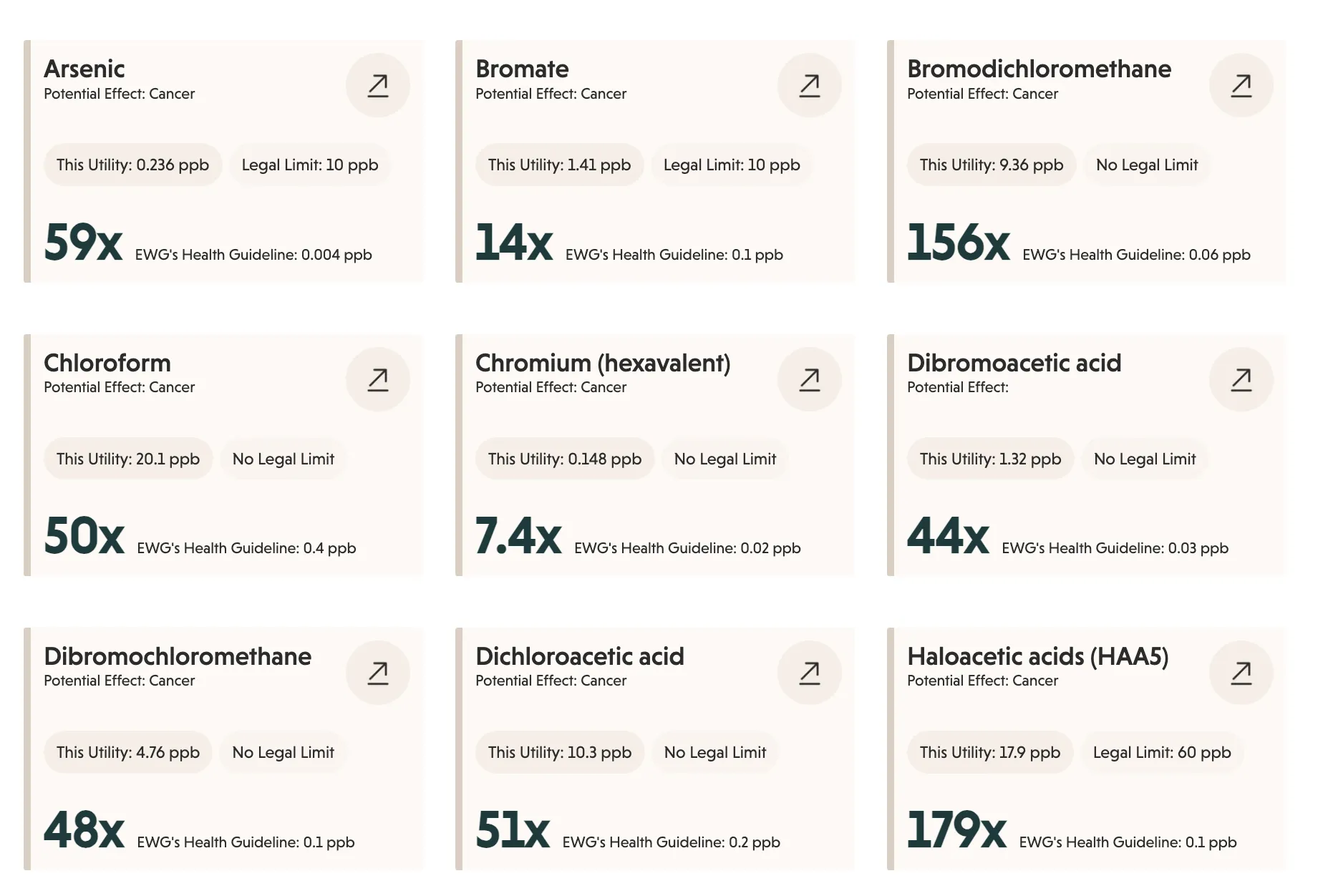
Twenty contaminants came in above EWG’s health guidelines. These are the ones most worth understanding, with the amount found, EWG’s guideline and the federal legal limit:
- Arsenic: 0.236 ppb found, against an EWG guideline of 0.004 ppb and a legal limit of 10 ppb
- PFOA: 10.9 ppt found, against a federal limit of 4 ppt that utilities don’t have to meet yet
- PFOS: 6.21 ppt found, against the same 4 ppt federal limit
- Chloroform: 20.1 ppb found, 50 times EWG’s guideline, with no separate federal limit
- Hexavalent chromium: 0.148 ppb found, 7.4 times EWG’s guideline, with no federal limit of its own
- Total trihalomethanes (TTHMs): 34.6 ppb found, against a legal limit of 80 ppb
(ppb means parts per billion; ppt means parts per trillion.)
You can see all 20 contaminants on EWG’s United Water NJ page.
Legal Limits vs Health Guidelines: Why Both Numbers Matter
United Water NJ was in compliance with federal drinking water standards for the most recent quarter EWG assessed, April through June 2024. Nothing in this data shows the utility breaking the law.
The gap between “legal” and “recommended” comes from how each number gets set:
- Federal limits weigh health risk against treatment cost and what utilities can realistically achieve.
- EWG’s guidelines are based on health risk alone. For contaminants linked to cancer, that’s usually the level tied to a one-in-a-million cancer risk.
- Many federal limits are decades old. The arsenic limit was set in 2001, and the trihalomethane limit dates to 1998.
- Some contaminants, like hexavalent chromium, have no federal limit at all.
The legal limit tells you whether your utility is doing its job. The health guideline tells you what’s worth reducing at home if your family drinks this water every day.
The Contaminants Worth Knowing About
PFAS (“Forever Chemicals”)
PFAS are man-made chemicals used in nonstick cookware, stain-resistant fabric and firefighting foam. They break down extremely slowly, so they build up in water supplies and in the body.
In 2024, the EPA set the first federal limits for PFOA and PFOS at 4 ppt each. Both local readings are above that. Those federal rules are now being revised, and the compliance deadline is moving toward 2031, so a fix on the utility side could be years away.
New Jersey has its own enforceable limits, set in 2020: 14 ppt for PFOA and 13 ppt for PFOS. These readings fall under the state limits. So PFAS in drinking water here is legal today but above where the federal standard is headed.
Arsenic
Arsenic occurs naturally in the bedrock and groundwater across much of northern New Jersey. The local level, 0.236 ppb, is well under the 10 ppb legal limit and 59 times EWG’s guideline.
You can’t taste, see or smell arsenic in drinking water. Long-term exposure is linked to bladder, lung and skin cancer, which is why EWG’s guideline sits so far below the legal limit. Boiling doesn’t remove it either. Boiling evaporates water and leaves arsenic behind, slightly concentrating it.
Disinfection Byproducts (Chloroform, TTHMs, Haloacetic Acids)
Utilities add chlorine to kill bacteria and viruses. When chlorine reacts with natural organic matter like decaying leaves and soil, it forms byproducts. Chloroform is one of four trihalomethanes, and haloacetic acids are a second group that forms the same way.
Disinfection prevents serious waterborne illness, and nobody’s suggesting utilities stop. The byproducts are the trade-off, and long-term exposure is linked to cancer risk. Chloroform also evaporates easily, which means you breathe some in during a hot shower.
Hexavalent Chromium and Nitrate
Hexavalent chromium comes from industrial sources and can also occur naturally. There’s no federal limit for this form specifically. The 100 ppb limit for total chromium covers all forms combined.
Nitrate is also on EWG’s list for this system. It usually comes from fertilizer, septic systems and stormwater runoff. The federal limit is 10 ppm, set mainly to protect infants, so it’s worth paying attention to if you mix formula with tap water.
How to Find Out What’s in Your Water
Bergen County doesn’t have one water supplier. Ridgewood Water, for example, is a separate municipal system serving Ridgewood, Glen Rock, Midland Park and Wyckoff. Start by finding out who supplies your home:
- Check your water bill for your utility’s name.
- Look up your utility’s annual Consumer Confidence Report.
- Search your utility or ZIP code in the EWG Tap Water Database.
When you open the Consumer Confidence Report, look for the “highest level detected” column and compare it to the MCL (maximum contaminant level) column next to it.
Your Tap Isn’t the Treatment Plant
Utility reports measure water at the plant and in the distribution system, not at your faucet. Older homes can pick up lead from service lines, solder and fixtures on the way from the street to your kitchen.
New Jersey law requires water systems to replace all lead service lines by 2031, and utilities have to post an inventory showing which lines are lead or unknown. Look up your address in your utility’s inventory. Our guide on How to Identify Lead Pipes in Your Home shows what to look for where the line enters your basement, and our team handles water line repair and replacement on the homeowner’s side.
Until you know, two habits help. Run the cold tap for a minute or two if the water’s been sitting overnight, and use cold water, never hot, for drinking and cooking.
Get a Read on Your Own Water
Gladiator offers free water testing with any service visit. It checks the basics, including TDS, pH, iron, nitrates and chlorine. If you want exact numbers for PFAS or arsenic, a state-certified lab test is the most precise option.
Reverse Osmosis vs Carbon Filters vs Whole-House Systems
Pitcher and Faucet Carbon Filters
- What they treat: chlorine taste and odor, some disinfection byproducts
- Where they treat: one pitcher or one faucet
- What they miss: arsenic and hexavalent chromium aren’t reliably removed
- Upkeep: cartridge changes every two to six months
Under-Sink Reverse Osmosis
- What it treats: EWG’s filter data shows RO covers all 20 contaminants flagged in this water, including PFAS, arsenic, lead and hexavalent chromium (carbon covers 16)
- Where it treats: a dedicated drinking and cooking faucet at the kitchen sink
- Trade-offs: sends some water down the drain as it filters and needs cabinet space for the tank
- Upkeep: pre-filters about once a year, membrane every two to three years
Whole-House Filtration and Softeners
- What they treat: chlorine, byproducts, taste, odor and hardness, depending on the setup
- Where they treat: every tap and shower in the house
- Best fit: families concerned about shower exposure or hard water scale
- Upkeep: media replacement or salt refills on a set schedule
Many homeowners pair a whole-house system with an RO unit at the kitchen sink.
What to Look for on the Label
If you’re shopping for an RO system, look for NSF/ANSI 58 certification. That’s the standard for under-sink reverse osmosis. Then check which specific claims the system is certified for, since certification is claim-by-claim. For this water, you’d want PFOA/PFOS reduction and arsenic reduction on the list.
Reverse osmosis system cost depends on the unit, the number of filter stages and your plumbing layout. We give you a flat-rate quote before any work starts.
Why Professional Installation Matters
A filter only works if it’s the right one for your water. We size systems to your test results instead of guessing, so you’re not paying for treatment you don’t need or missing a contaminant you do have.
The install itself matters too. An RO unit needs a proper drain connection, an air gap or check valve and a dedicated faucet. A whole-house system has to go in at the right spot on your main line, usually after the meter and before the water heater.
Gladiator installs reverse osmosis, whole-house filtration and water softeners, along with iron removal, carbon filtration and acid neutralization systems.
Find Out What’s Coming Out of Your Tap
Meeting the legal limit and being as healthy as it could be are two different bars. The only way to know where your own water lands is to test it. We filter our own water at home, and we’d tell any family drinking straight from the tap to look into it.
Book a water test and quote with our team, and we’ll help you figure out what your home needs.
FAQs
Is Bergen County tap water safe to drink?
Veolia Water New Jersey, formerly United Water NJ, met federal standards in its latest assessed quarter, but EWG found 20 contaminants above its health guidelines, including arsenic and PFAS. Water quality varies by utility, so check your own report or have your water tested.
Does reverse osmosis remove PFAS?
Yes. Reverse osmosis is one of the most effective home treatments for PFAS. Look for a system certified to NSF/ANSI 58 with a PFOA/PFOS reduction claim, and keep up with filter changes.
Does reverse osmosis remove arsenic?
Yes. RO is very effective on the form of arsenic found in chlorinated city water. Check that the system you choose lists arsenic reduction among its certified claims.
Does a Brita filter remove arsenic or PFAS?
Brita’s Elite filter is certified to reduce PFOA and PFOS, but its standard filter isn’t. Neither is certified to reduce arsenic.
Is bottled water a better option?
Not necessarily. Quality varies by brand, and the cost adds up. A home RO system gives you filtered water on tap for much less per gallon.
How often do RO filters need to be changed?
Most pre-filters and carbon filters need replacing every 6 to 12 months, and the membrane usually lasts two to three years.
 All Service Areas
